Ideas are overrated. Execution is not.
In classrooms, pitch competitions, and innovation labs, we celebrate the spark. The big idea. The bold solution. The “what if.” But research consistently shows that startups do not fail because of bad ideas alone. They fail because teams cannot execute, adapt, and scale those ideas.
For mission-driven startups, this is even more critical. Because when you are not only building a company but trying to solve a social, environmental, or systemic issue, complexity multiplies. A great idea without a great team does not create impact. It creates frustration.
What Research Says About Team Impact
CB Insights, in its analysis of startup post-mortems, identified team-related issues as one of the top reasons startups fail. This includes lack of the right skills, internal conflict, misalignment among founders, and weak execution capacity.
Startup Genome’s Global Startup Report found that startups with balanced founding teams significantly outperform solo founders. Teams that combine technical expertise, business acumen, and market knowledge are more likely to reach scale and secure funding.
Harvard Business School research also highlights that investors often evaluate the team more heavily than the idea. Markets evolve. Technology shifts. Business models pivot. But a strong team can navigate uncertainty. A weak one cannot.
For mission-driven ventures, the stakes are even higher. You are operating at the intersection of purpose and performance. That requires strategic clarity, operational discipline, and value alignment.
Mission-driven founders sometimes assume that shared passion is enough. It is not. Passion builds energy, but capability builds systems. A startup seeking scalable impact must blend purpose with operational strength. That means having people who understand market dynamics, manage cash flow responsibly, design and refine products, and people who communicate the mission clearly to customers and stakeholders.
Diversity of skill sets plays a crucial role in this equation. Research from MIT Sloan suggests that cross-functional teams are better at solving complex problems and innovating effectively. When technical thinkers, strategists, operators, and storytellers collaborate, blind spots shrink. In social enterprises, this diversity ensures that impact ambition is grounded in financial and operational reality. Without that balance, even the most well-intentioned venture risks instability.
Ideas are overrated. Execution is not.
In classrooms, pitch competitions, and innovation labs, we celebrate the spark. The big idea. The bold solution. The “what if.” But research consistently shows that startups do not fail because of bad ideas alone. They fail because teams cannot execute, adapt, and scale those ideas.
For mission-driven startups, this is even more critical. Because when you are not only building a company but trying to solve a social, environmental, or systemic issue, complexity multiplies. A great idea without a great team does not create impact. It creates frustration.
What Research Says About Team Impact
CB Insights, in its analysis of startup post-mortems, identified team-related issues as one of the top reasons startups fail. This includes lack of the right skills, internal conflict, misalignment among founders, and weak execution capacity.
Startup Genome’s Global Startup Report found that startups with balanced founding teams significantly outperform solo founders. Teams that combine technical expertise, business acumen, and market knowledge are more likely to reach scale and secure funding.
Harvard Business School research also highlights that investors often evaluate the team more heavily than the idea. Markets evolve. Technology shifts. Business models pivot. But a strong team can navigate uncertainty. A weak one cannot.
For mission-driven ventures, the stakes are even higher. You are operating at the intersection of purpose and performance. That requires strategic clarity, operational discipline, and value alignment.
Mission-driven founders sometimes assume that shared passion is enough. It is not. Passion builds energy, but capability builds systems. A startup seeking scalable impact must blend purpose with operational strength. That means having people who understand market dynamics, manage cash flow responsibly, design and refine products, and people who communicate the mission clearly to customers and stakeholders.
Diversity of skill sets plays a crucial role in this equation. Research from MIT Sloan suggests that cross-functional teams are better at solving complex problems and innovating effectively. When technical thinkers, strategists, operators, and storytellers collaborate, blind spots shrink. In social enterprises, this diversity ensures that impact ambition is grounded in financial and operational reality. Without that balance, even the most well-intentioned venture risks instability.
Alignment, however, may be even more important than diversity. McKinsey research shows that organizations with aligned leadership teams significantly outperform those with internal fragmentation. In early-stage startups, misalignment often emerges around growth speed, risk tolerance, reinvestment priorities, or the balance between impact and profitability. These tensions are not inherently harmful, but if left unresolved, they quietly erode performance.
Mission-driven startups must be especially deliberate in defining their north star. Is impact the primary objective with profit as a sustainability tool? Or are both equal drivers of strategy? What trade-offs are acceptable? How will success be measured? Clarity at the beginning prevents conflict later.
Another overlooked dimension of strong teams is psychological safety. Google’s Project Aristotle identified psychological safety as the most critical factor in high-performing teams. When individuals feel safe to voice concerns, question decisions, and admit mistakes, learning accelerates. For startups operating in uncertainty, this is essential. The ability to pivot depends on honest feedback. In mission-driven ventures, where emotional investment runs high, maintaining open dialogue is even more important. Disagreement should refine strategy, not fracture relationships.
The European Bank for Reconstruction and Development emphasizes that startups operate in environments of constant uncertainty and must test assumptions rapidly. Teams that establish clear roles, defined decision-making processes, and measurable performance indicators outperform those that rely solely on enthusiasm.
If you are a student entrepreneur or early-stage founder, do not just choose co-founders because they are your friends or share your passion.
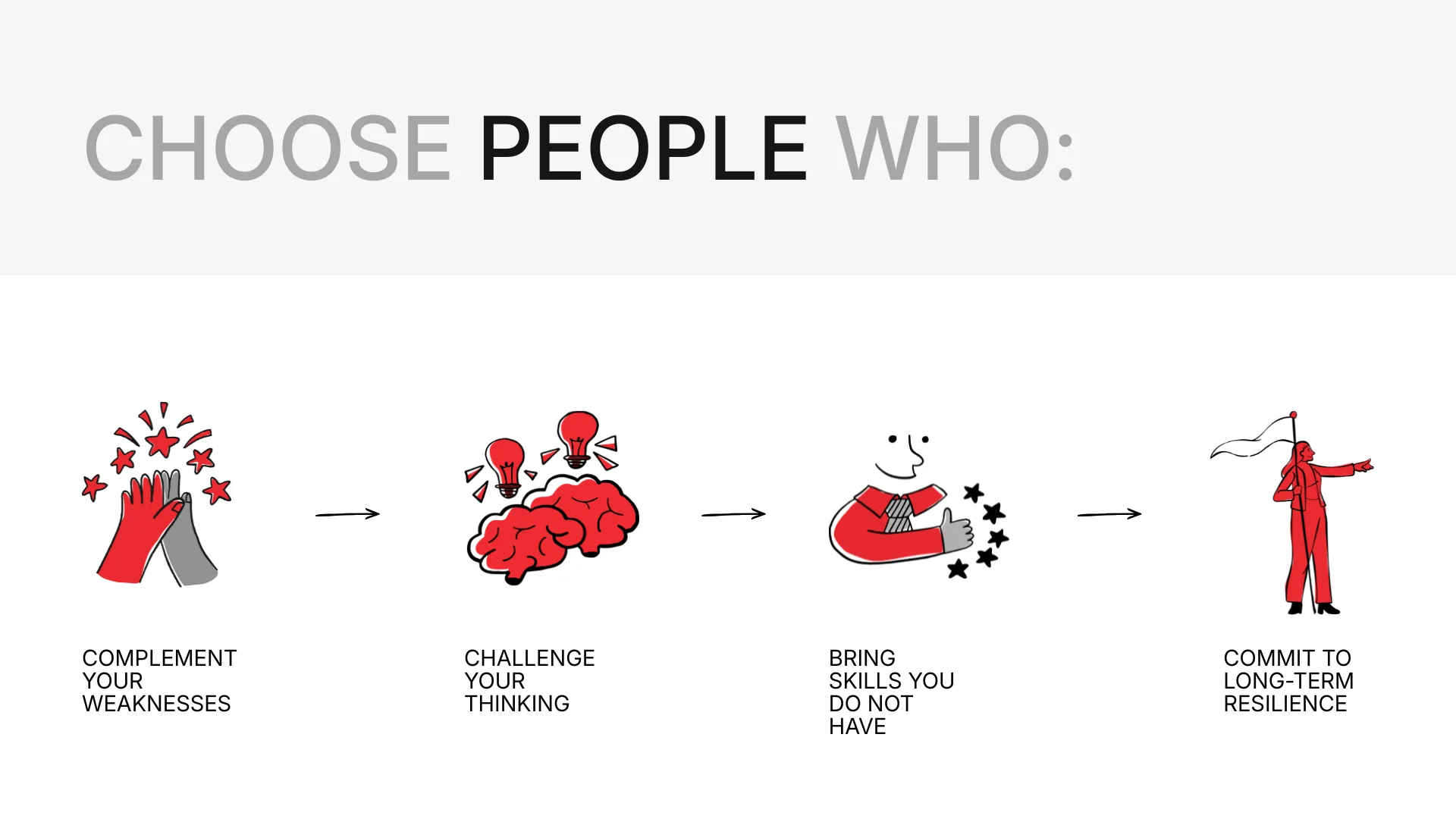
Choose people who:
· Complement your weaknesses
· Challenge your thinking
· Bring skills you do not have
· Commit to long-term resilience
Look beyond technical talent. Emotional intelligence, adaptability, and discipline matter just as much.
Impact startups require endurance. Social change rarely moves at startup speed. Your team must be able to withstand slow traction, funding gaps, and iteration cycles without losing direction.
In the venture world, there is a common phrase: investors invest in teams, not ideas. The logic is simple. A great team can improve, pivot, or even completely redesign an idea. A weak team can undermine even the strongest concept.
For mission-driven startups, this insight carries additional weight. You are not only responsible to customers or investors. You are accountable to communities and causes. Building the right team is not just a strategic decision; it is an ethical one.
At GMI, we believe that measurable impact requires disciplined execution. That discipline lives within teams. A great idea may inspire the beginning. But it is the team that determines whether that idea becomes scalable, sustainable change.
In the long run, the strength of your mission will be measured by the strength of the people building it.